editing, leadership and team building
Clip from Arlingtonian’s beginning of the year introduction and candy salad creation.
Involvement in journalism:
Journalism I and II classes (9)
Staff Writer, Arlingtonian (10)
Managing Editor, Arlingtonian (11)
Editor in Chief, Arlingtonian (12)
During my first year as a staff writer for Arlingtonian, I was a sophomore in high school and trying finding my place in the newsroom. While it quickly became my a place where I felt inspired most, I began to notice that collaboration was limited by titles. A huge divide existed between editors and writers, one that made underclassmen like myself hesitant to engage fully in conversations and asking for help. With that divide, there seemed to be a lingering chaos that seeped into everyone's mind. Print deadlines were missed and typos were consistent. What concerned me most wasn’t the quality of the final product, but the fact that underclassmen didn’t feel warranted to understand or contribute to the full publishing process.
These gaps pushed me to think differently about leadership and organization. I have been heavily involved in my school's business classes, taking Higher Level IB Business Management (2 year) and AP Macroeconomics and Microeconomics. Through these classes, I learned how successful organizations balance structure, accountability, and sustainability. While Arlingtonian is not a business, I approached my role as editor in chief with the mindset of building a sustainable organization rather than simply producing each issue and repeating a process. I believed that a newsroom could be both structured and collaborative, and that leadership should clarify roles without discouraging involvement.
In a business environment, there is a hierarchy of people who each have jobs to contribute to the success of the company. From editors to staff writers, this type of structure is necessary for accountability and efficiency purposes. However, I was intentional about making sure this didn’t create the gap I’ve witnessed in years prior.
As editor in chief, I work to preserve the hierarchy while redefining how it functioned. For each issue, everyone, regardless of their position on staff, is included in the pitching/brainstorming session. In years past, photographers, designers, business managers and artists have been excluded from this conversation. Now, by including all roles in the conversation, story ideas have become more well rounded and reflective of our school.
After brainstorming, the Google document of ideas is shared with writers and each writer is tasked with commenting on three story ideas that they would like to write. Previously, writers were assigned stories by the editor in chief. Letting writers select a few options of stories allows each writer to have more input in the issues final draft leading to greater writer initiative and overall excitement about their work. From this, I have seen writers become more consistent in meeting deadlines and take greater ownership over revisions, often requesting additional feedback.
Creating a collaborative newsroom also meant creating structure that supported it. Being a student myself, I noticed that we all live off of Canvas calendars and daily plans from our other classes, so I wanted to recreate something similar for Arlingtonian. Each day of class, my laptop is mirrored to the screen in our room with a detailed plan of what we will be working on that day. Before each week, I update the planning slides so that if you are absent you can still follow along. In August, I met with our advisor, Robin Mollica, to discuss the printing schedule of our year. I made an online calendar that shows our print, brainstorm, editing and writing days so that students can get a glimpse of what is coming up.
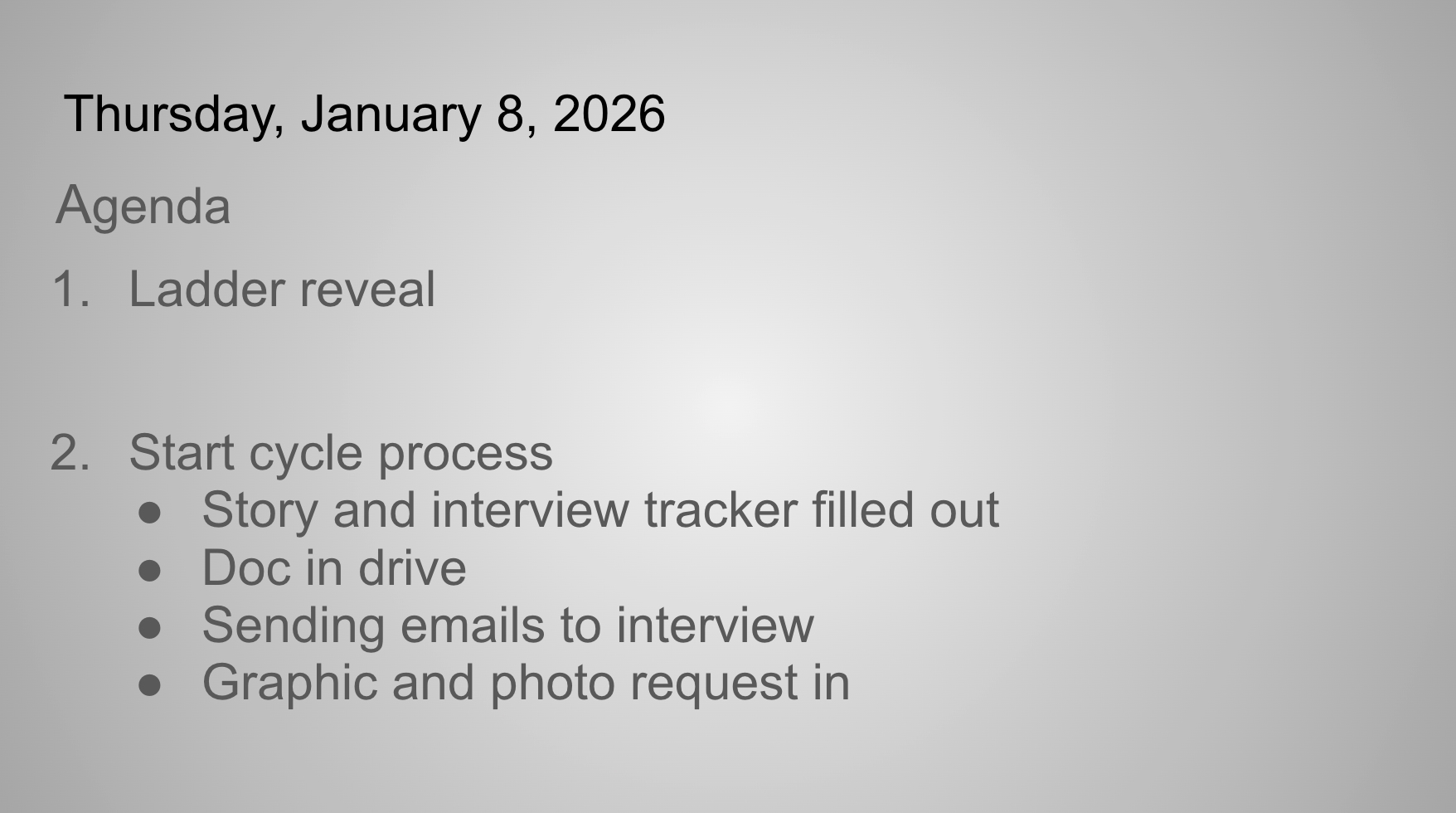

Examples of our daily plan in Arlingtonian looks like.
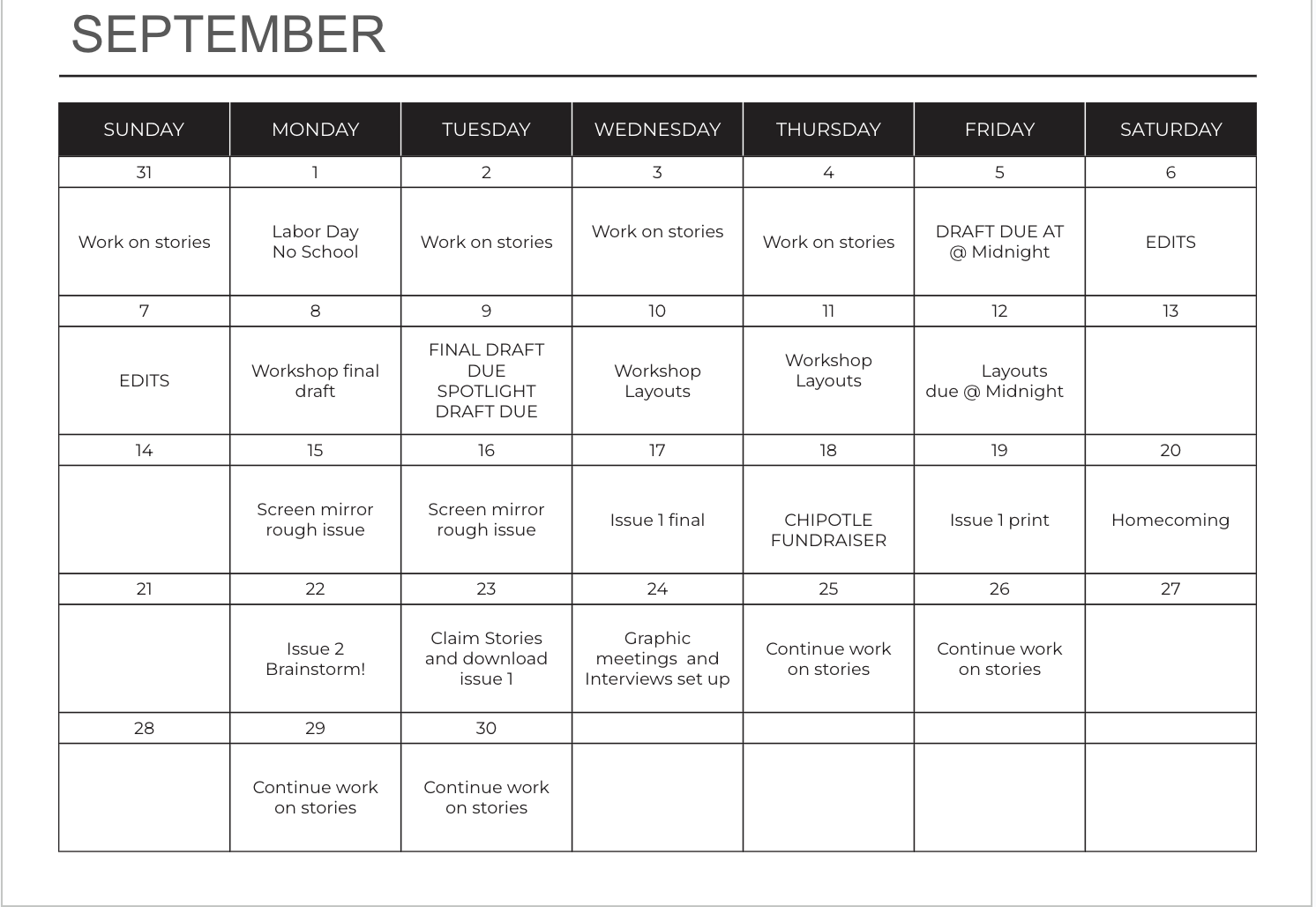
Example of Arlingtonian’s monthly calendar, shared with staff.
This seemingly small addition of shared calendars and clear planning had a major effect. The chaos that once filled the newsroom all but disappeared. Since adding these systems, Arlingtonian has gone to print on schedule with noticeably fewer last minute corrections, making print days intentional rather than frantic.
In previous years, print days screamed urgency. Instead of pausing to appreciate the issue we had created, the newsroom felt way too rushed and tense. I set out to change that by intentionally building more time into the editing process. It began with mapping out print dates well in advance, then assigning each issue a full week of buffer time. The final two days of that week became screen mirror days. During these sessions, the rough draft of the issue was projected while staff followed along on their laptops. Page by page, we discussed visual balance, commented on errors, and acknowledged what was working well. These conversations significantly reduced the amount of mistakes that were seen in previous years and made print days into a far more positive environment.
This year, Arlingtonian grew to its largest staff in school history. With more than thirty staff members, our class expanded into two periods. I worked closely with my counselor to restructure my schedule so I could be present in both periods, making sure the publication kept consistent leadership and communication. My bigger concern, however, was preserving a culture as the staff grew. With help from our social chair manager, Evelyn Jones, we introduced monthly morning meetings held before school. These gatherings were a time for connecting both classes.
Ultimately, my goal as editor in chief was to build a newsroom that could thrive beyond my time in the role. By establishing systems that preserved transparency and collaboration, I watched our staff grow more confident in their respective roles and more invested in the publication as a whole. The newsroom completely shifted from a space that was stressful to one that had trust and ownership.